鹤 · Hè
The Crane That Outlives Dynasties
系列: 神兽灵禽 · Design #03
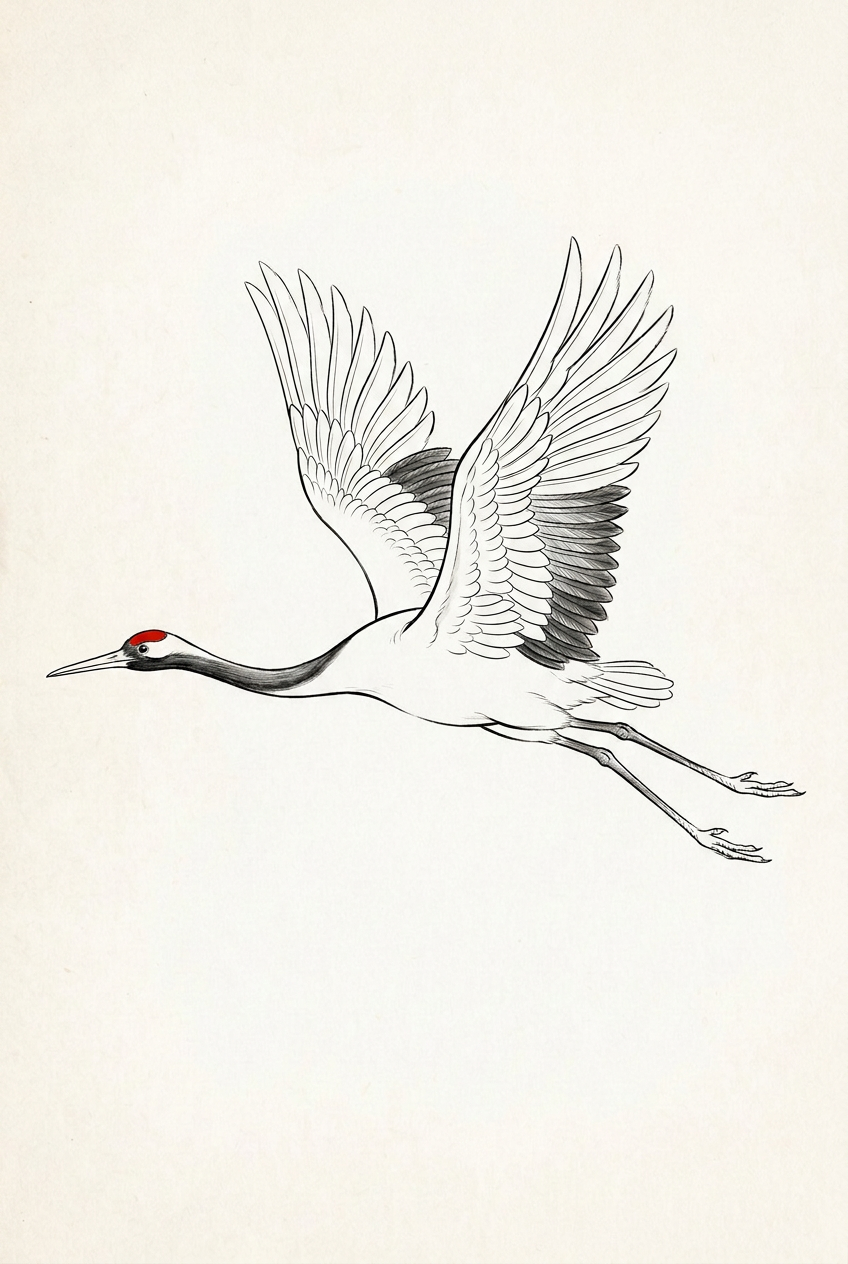
笔法: Red-crowned crane, neck extended or wings spread · fine-line negative space · optional pine branch or single cloud
形态: 丹顶鹤引颈或振翅主体,可配松枝或云纹
名字
仙鹤(xiān hè)——丹顶鹤:长寿与超脱之鸟。通体素白,顶一点朱红,飞行时颈腿舒展如书法长线。
*xian hè* — the red-crowned crane: bird of longevity and transcendence. Snow-white body, one drop of vermilion on the crown, neck and legs drawn out in flight like the long strokes of calligraphy.
出处
《诗经·小雅·鹤鸣》(约前 8–前 6 世纪):鹤鸣于九皋,声闻于天。道教传统:仙人骑鹤往来天上(驾鹤西归即由此来)。核心 provenance:《瑞鹤图》(1112 年,宋徽宗赵佶亲绘,现藏辽宁省博物馆)。形制参考:鹤纹见于宋至清的绘画、瓷器与品服徽章。 本设计未使用任何第三方源图像。
*Book of Songs, "The Crane Cries in the Ninth Marsh"* (c. 8th–6th century BC): "The crane cries in the ninth marsh — the sound is heard in heaven." Daoist tradition: immortals ride cranes through the sky (the origin of "riding the crane westward"). Core provenance: *Auspicious Cranes* (瑞鹤图), painted by Emperor Huizong of Song in 1112, held today at the Liaoning Provincial Museum. Historical form reference: Crane motifs appear across Song-Qing painting, ceramics and rank badges. No third-party source image was used for this design.
设计灵感
设计灵感
本版每一处形制决定都有出处可查,逐条对账。① 鸣声之喻——《诗经·鹤鸣》:「鹤鸣于九皋,声闻于天。」② 仙人之骑——道教骑鹤传统,「驾鹤西归」由此而来。③ 工笔范式——宋徽宗《瑞鹤图》(1112),存世最经典的鹤画记录。④ 识别特征——丹顶、黑颈、颈直前飞——真实丹顶鹤自身的规格,stencil 如实携带。
Every form decision on this design points to a recorded source, element by element. ① The voice metaphor — *Book of Songs*, "The Crane Cries in the Ninth Marsh": the sound is heard in heaven. ② The immortal's mount — the Daoist crane-riding tradition behind "riding the crane westward." ③ The gongbi standard — Emperor Huizong's *Auspicious Cranes* (1112), the canonical painted record of the bird. ④ The field marks — red crown, black neck, neck-extended flight: the real bird's own specification, carried into the stencil.
来历
来历
公元 1112 年正月十六的黄昏,汴京上空出现异象:一群白鹤绕着宣德门盘旋飞鸣,久久不散,另有两只稳稳落在殿脊鸱吻上,仿佛朝仪。
皇帝宋徽宗赵佶亲眼看见了这一幕。他是中国历史上艺术造诣最高的皇帝——书法自成一体的画家。他没有让祥瑞只停留在传说里,而是铺开绢本,用工笔把十八只鹤的姿态一一描下,亲题"瑞鹤"二字,并写下长跋记录当日情景。九百年后,这幅《瑞鹤图》完好地保存在辽宁省博物馆里——你可以真实地看到那个黄昏。
中国人为什么把鹤抬到这么高?因为它身上同时压着三重筹码:
其一,它是真实的。鹤不是龙凤那种想象生物——它真实活在中国人的湿地与天空里,寿命可达五六十年,是真正"活得久"的鸟。想象永远不如真实有力量,鹤的神性建立在可见的优雅之上。
其二,它的声音传得远。《诗经》就说"鹤鸣于九皋,声闻于天"——鹤在深泽里叫一声,天上都听得见。这成了中国文人最钟爱的隐喻:君子在野,声名在朝。你不必站在权力中心,真正的价值自己会发声。
其三,它看起来像解脱。鹤通体素白,顶一点朱红,飞行时颈腿舒展如书法长线——道教想象仙人骑鹤白日飞升,连"去世"都雅称"驾鹤西归"。鹤是死亡的柔化,是从人间解脱出去的航班。
于是中国人把"活得久、传得远、走得脱"三样最深的愿望,全部交给了这一只鸟。给老人祝寿画鹤,为科举祈福也画鹤(鹤与"贺"谐音)。它是中国唯一一只同时管生、管名、管死的鸟。
把它纹在身上,纹的是一份长寿的祝愿——也是"声闻于天"的自许:我的声音,会传到我该抵达的地方。
On the evening of the sixteenth day of the first month, 1112 AD, an omen appeared over the capital of Bianjing: a flock of white cranes circling the palace gate, crying in the twilight. Two of them descended and settled on the ridge of the roof, as if attending court.
Emperor Huizong of Song saw it with his own eyes — the most artistically gifted emperor in Chinese history, a painter whose calligraphy founded a school. He did not let the omen fade into rumor. He unrolled silk and painted all eighteen cranes in meticulous gongbi brushwork, titled it *Auspicious Cranes* with his own hand, and wrote a colophon recording the exact date. Nine hundred years later, that painting survives intact in the Liaoning Provincial Museum — you can still look at that evening.
Why did the Chinese raise the crane so high? Because three of their deepest wishes land on its wings.
First, it is real. Unlike dragons or phoenixes, cranes live in China's actual wetlands — and they live long, fifty or sixty years, a genuinely enduring bird. Divinity built on visible grace is stronger than divinity built on imagination.
Second, its voice carries. The Book of Songs said it first: "The crane cries in the ninth marsh; the sound is heard in heaven." This became the literati's favorite metaphor: a gentleman in the wilds, whose worth is heard at court. You don't need to stand at the center of power. Real value announces itself.
Third, it looks like liberation. Snow-white body, one drop of vermilion on the crown, wings and legs drawn out in flight like the long strokes of calligraphy. Daoists imagined immortals riding cranes into the sky; even death itself is elegantly renamed in Chinese — "riding the crane westward." The crane is how death is made gentle.
So the Chinese handed this one bird their three greatest hopes: to live long, to be heard far, to leave freely. Birthday paintings for elders feature cranes; examination prayers feature cranes. It is the only bird in China that governs life, name, and death at once.
To wear it is to wear a wish for long life — and a quiet boast from the Book of Songs: *my voice will reach wherever it is meant to arrive.*
释义
释义
鹤鸣于九皋,声闻于天。鹤管三愿——长寿(活得久)、声名(传得远)、超脱(走得脱)。适合纪念"熬过长跑"、追求长期主义、或为长辈祈福纹身的人。
The crane cries from the deepest marsh — and heaven hears. The crane carries three wishes at once: longevity (a long life), renown (a voice that carries), and transcendence (leaving freely). For marking a long road finally crossed, for long-game believers, and for memorials honoring elders.
位置
位置
鹤身纵线贴臂骨走向极佳:经典位是大臂外侧,其次肋侧、小腿内侧;展翅横构图适合肩背。中幅 10–18 厘米为完整主体;细线小鹤 5–8 厘米适合脚踝/腕上。可配松枝(松鹤延年)或单云纹。
The crane's long vertical line follows the arm bone beautifully: the outer upper arm is the classic spot, with the ribs and inner calf close behind. A spread-winged horizontal composition suits the shoulder blade. Medium 10–18 cm for the full bird; a fine-line crane at 5–8 cm sits perfectly above the ankle or wrist. Pair with a pine branch (pine-and-crane longevity) or a single cloud if you want company for it.
纹之前
纹之前
鹤与鹭、鹳易混:丹顶鹤头顶有红点、颈黑腿长、飞行时颈直向前——stencil 必须含此特征,混了就"不是它"。② "驾鹤西归"关联死亡意象,给长辈做纪念纹身时无需回避但可自选侧重(松鹤延年偏祝寿,孤鹤云上偏超脱)。③ 中日文化中鹤皆吉,无排异风险;黑白灰 ink 下以留白表现素羽是效果关键。④ 墨线 + 一点朱红。 线稿保持纯黑,丹顶朱红是全图唯一颜色,素羽以留白为生命——勿以灰面填羽。丹顶在 stencil 上以轮廓留白呈现,由纹身师参照设计稿填红。⑤ 留够尺寸。 竖向不小于 10 厘米保腿线;高磨损位(腕、踝)会毁掉留白。
Cranes, herons, and storks blur easily — the red-crowned crane has a red crown spot, a black neck, long legs, and flies with neck extended straight forward. The stencil must carry these markers; without them it is simply "not this bird." ② "Riding the crane westward" connects to death imagery — no need to avoid it for memorial pieces, but choose your emphasis: pine-and-crane leans birthday-blessing, a lone crane among clouds leans transcendence. ③ In both Chinese and Japanese culture the crane is auspicious, so there is no cross-cultural risk; in black-and-grey ink, the white feathers are rendered by leaving skin — negative space is where the effect lives or dies. ④ Ink plus one spot of red. The linework stays black with a single vermilion crown spot as the only color; the white feathers live as negative space — do not fill them with grey wash. The stencil carries the crown as an outlined patch: your artist fills it red from the design sheet. ⑤ Respect the scale. At least 10 cm vertical so the leg lines stay fine; negative space dies fast on high-friction spots (wrist, ankle).
本卡每一个汉字都由中文母语者选定并逐笔核对。