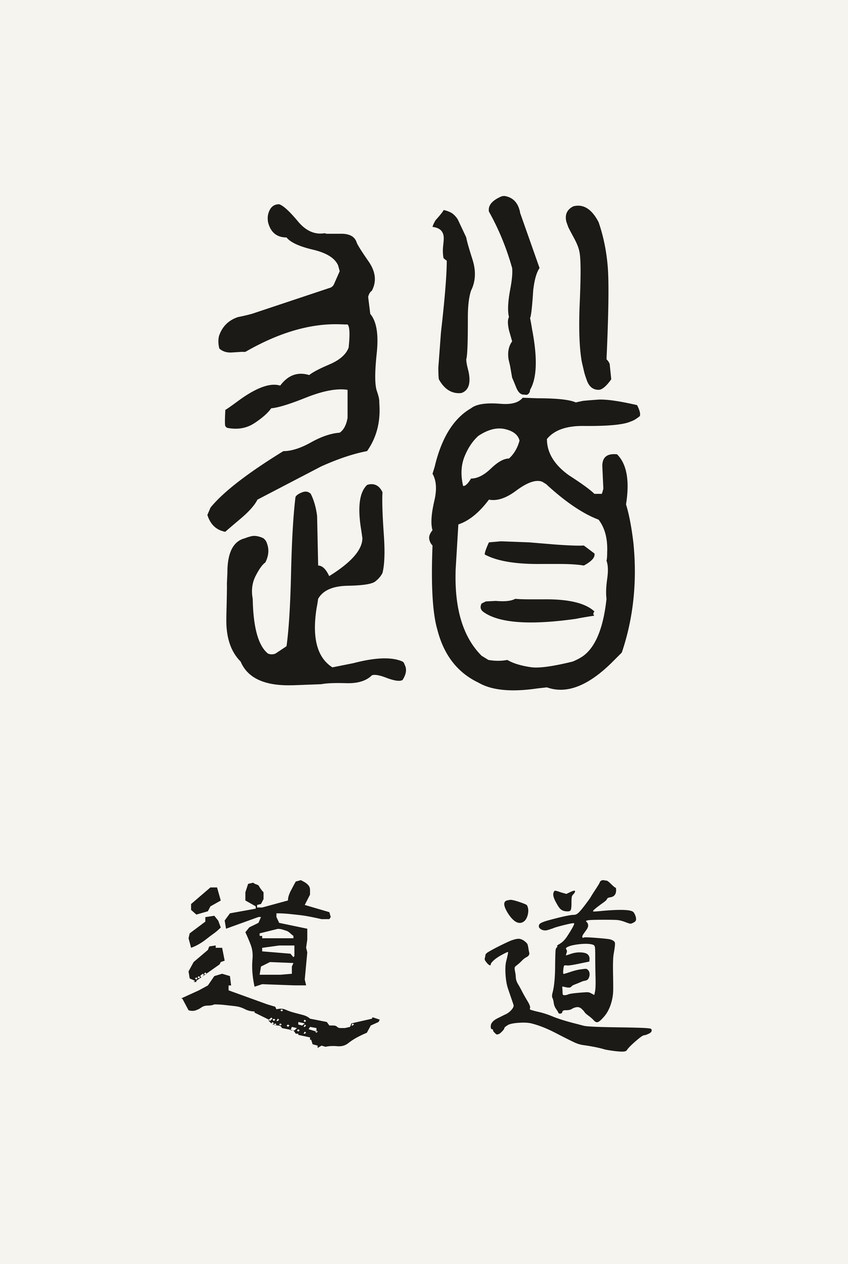
道 · Dào
The Way
Series: Single-Character Zen · Design #01
Style: Single character · one sheet, three scripts: small-seal large on top, clerical & regular smaller below · optional etymology strip
Form: 文字
The Name
One character, and the oldest philosophical question in it: *dào* — the Way, the path beneath all paths. Its oracle-bone form is three thousand years old: a crossroads, with a single person standing in the middle. Person + Road = Dao.
道(dào)——一个字里装着最古老的哲学命题:路之下的一切路。它的甲骨文形态已有三千年:一个十字路口,中间站着一个人。人 + 路 = 道。
Source & Provenance
Etymology: the oracle-bone graph combines "crossroads" (行) with "person" (人) — the original meaning is simply *a road being walked*. *Tao Te Ching*, Chapter 1 (Laozi, c. 6th century BC): "The Dao that can be spoken is not the eternal Dao." Chapter 25: "There was something formed in chaos, born before heaven and earth... I do not know its name; I style it *Dao*." Historical form reference: Character construction and calligraphic treatment of 道 are attested across Han-Song calligraphic traditions. No third-party source image was used for this design.
字源:甲骨文从"行"(十字路口)从"人"——一个人走在路上,本义即道路。《道德经》第一章(春秋·老子,约前 6 世纪):道可道,非常道;名可名,非常名。第二十五章:有物混成,先天地生……吾不知其名,字之曰道。形制参考:「道」字的构形与书法处理,见于汉至宋各代书法传统。 本设计未使用任何第三方源图像。
Design Inspiration
Design Inspiration
Every form decision on this design points to a recorded source, element by element. ① The oracle-bone graph — 行 crossroads plus 人 person, a three-thousand-year-old pictogram of a road being walked. ② The two anchor citations — *Tao Te Ching*, chapters 1 and 25 (Laozi, c. 6th century BC). ③ The calligraphic treatment — the character's attested forms across Han–Song calligraphic traditions; the seal-script option carries the ancient Chinese shape itself.
本版每一处形制决定都有出处可查,逐条对账。① 甲骨文字形——从「行」从「人」,三千年前的「在路上」象形。② 两处锚点引文——《道德经》第一章与第二十五章(老子,约前 6 世纪)。③ 书法处理——「道」字见于汉至宋书法传统的历代形态;篆书版即古汉字形态本身。
The Story
The Story
Three thousand years ago, a scribe carved the oldest known form of the character dào onto an ox bone: a crossroads, with a single person standing in the middle.
Person + Road = Dao.
That is where the Chinese concept of the ultimate begins — not in the heavens but on the ground; not divine revelation but walking. The truth of the world, in this view, is not somewhere else. It is in the road under your feet and the manner in which you walk it.
In the 6th century BC, an aging royal archivist named Laozi watched the Zhou dynasty decay, mounted a black ox, and rode west toward the Hangu Pass. The gatekeeper saw purple qi drifting from the east — the aura of a sage — and stopped him, begging for a book. Laozi stayed a few days, wrote five thousand characters, and rode on into the west, never to be seen again.
The opening of those five thousand characters is the most famous sentence in Chinese philosophy:
The Dao that can be spoken is not the eternal Dao.
Any Way you can fully explain is not the true Way. The opening move announces that everything to follow is merely a finger pointing at the moon — the finger is not the moon, the words are not the Dao. Read them, then go and walk it yourself.
From there, "dao" seeped into everything the Chinese touched: the stroke of a brush is a *dao*, tea has its *dao*, medicine, swordsmanship, even a bowl of noodles has its *dao*. Japan later borrowed the character and built kendō, shodō, kadō — but trace them all back, and you arrive at those five thousand characters at a mountain pass.
Dao is not a specific road. It is the study of walking itself: when to hasten, when to slow, when to yield, when to stay soft. Where Western philosophy asks *what is the world*, Dao asks *how shall we move through it*.
To wear this single character is to wear a three-thousand-year-old pictogram of person and road — a quiet declaration: *I am not at the destination. I am on the Way.*
三千多年前的某个刻工,在一片牛骨上刻下"道"字的最古形态:一个十字路口,中间站着一个人。
人 + 路 = 道。
这就是中国人对宇宙最高概念的起点——它不来自天上,来自地上;不是神启,是走路。中国人认为,世界的真相不在别处,就在你脚下正在走的那条路上,以及你走路的姿势里。
公元前 6 世纪,周王室藏书官李耳眼看周朝衰微,骑青牛西出函谷关。守关的官员尹喜望见紫气东来,知道有圣人过关,拦下他求书。老子在关前停了几天,留下五千字,继续西行,从此无人知其所终。
那五千字的开头,是中国哲学最著名的十二个字:道可道,非常道。
能被说清楚的道,就不是那个恒常的道。这个开局等于宣布:接下来五千字全部只是指月之指——手指不是月亮,文字不是道,读了之后你要自己去走。
道家的"道"随后渗进了中国人的每一个领域:书法讲"笔道",茶讲"茶道",医讲"医道",剑客讲"剑道",连做一碗面都有"面道"。日本人把"道"学去后发展出剑道、书道、花道——但追根溯源,都回到函谷关那五千字。
道不是一条具体的路,而是"走"本身的学问:什么时候快,什么时候慢,什么时候该退,什么时候守柔。西方哲学在追问"世界是什么",道在回答"世界怎么走"。
把它纹在身上的人,等于把"人+路"这个三千年的原始符号贴在了皮肤上——宣布自己不在终点,在路上。
What It Means
What It Means
The Way that can be told is not the eternal Way. Dao is a philosophy of process — no obsession with the destination, full attention on the walking; softness overcoming hardness, retreat as advance. For people in transition, long-game builders, and anyone who treats life as a practice rather than a race.
道可道,非常道。道是"过程哲学"——不执念终点、关注走路本身;柔能克刚、退即是进。适合正在转型期、长期主义者、以及"把人生当修行而非竞赛"的人。
Where It Sits
Where It Sits
The classic spot is the back of the neck — the canonical single-character position — with the inner forearm and below the collarbone close behind. At 3–8 cm this character works almost anywhere on the body. An optional etymology strip (oracle-bone to modern form) can accompany it, but the mainstream recommendation is the clean single character.
经典位是后颈——单字的教科书位置,其次前臂内侧、锁骨下方。3–8 厘米的字,几乎全身任意小幅位都成立。可选配"字源演变列"(甲骨文→楷书)辅助小图,但主流推荐是干净的单字版。
Before You Ink
Before You Ink
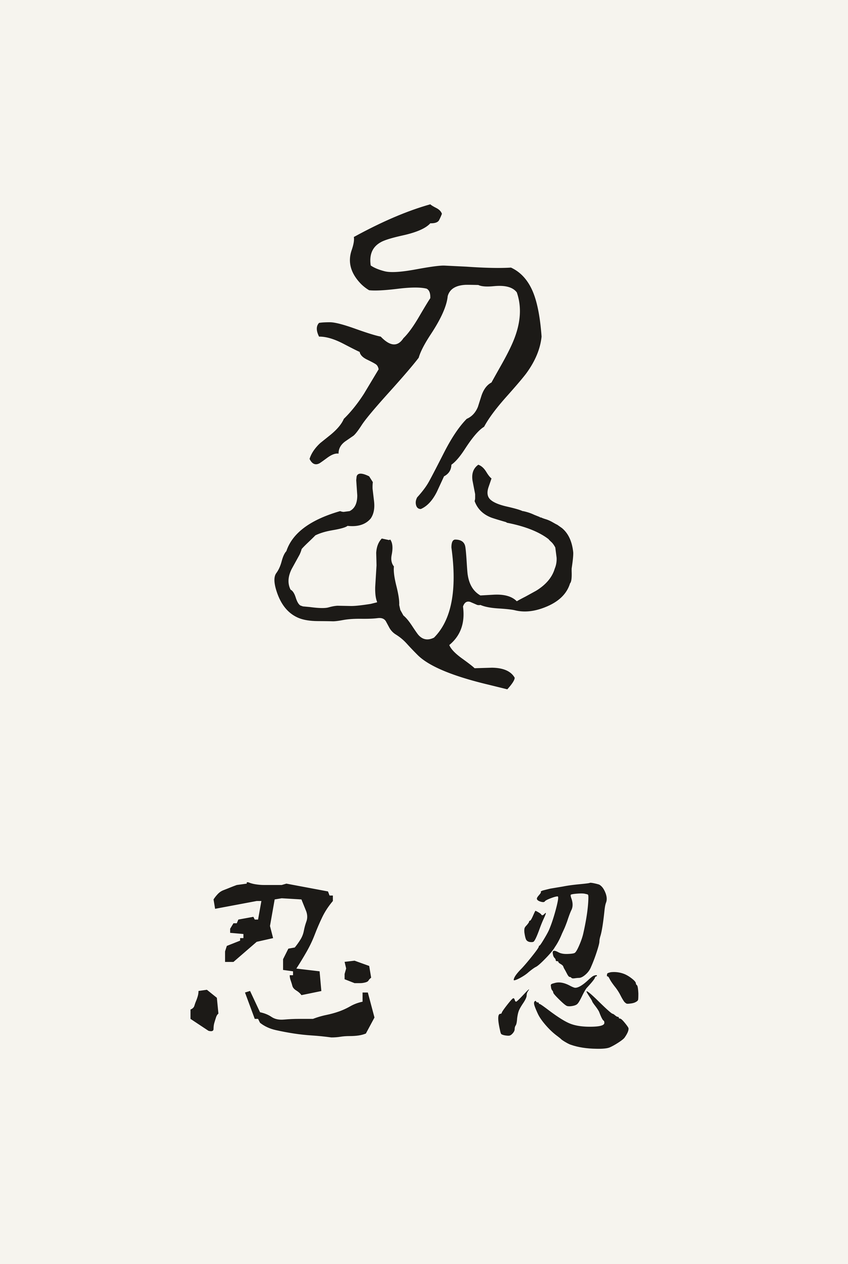
Script choice changes everything: seal script is archaic and scholarly, clerical script is steady and grounded, regular script is upright and modern — the sheet carries all three: small-seal script large on top, clerical and regular script smaller below. Choose one script and wear only that one — never combine two script versions of the same character in one tattoo. ② The character is identical to Japanese どう (dō); if you'd rather not be read as wearing a Japanese-style tattoo, the seal-script version unmistakably signals ancient Chinese form. ③ A single character forgives nothing — one crooked stroke ruins all of it. Use a verified glyph; never let a tattooist freehand a Chinese character. ④ Ink-only by design: the glyph is the drawing; color subtracts. ⑤ Scale and stencil. Keep the character at least 4 cm; transfer a verified glyph — the shipped glyph sheets are the only sanctioned forms.
篆书古雅、隶书沉稳、楷书端正——一图三体齐备:篆书大字在上,隶书、楷书略小在下,选好你真正要纹的那一体。任选一体、只纹一体——同一字的多体绝不并纹。② 此字与日本"道"(どう)写法相同,介意被误读为日式纹身者可选篆书体以强调古汉字形态。③ 单字纹身极简,一笔歪则全毁——务必用校验字形,勿让纹身师徒手"设计"汉字。④ 只宜墨线:字形即画面本身,加色减分。⑤ 尺寸与转印。 字面不小于 4 厘米;以 stencil 转印校验字形——随卡字形页是仅有的合规字形。
Every character on this card was selected and checked stroke by stroke by a native reader of Chinese.