蟒 · Mǎng
the Dragon You Earn
Series: Mythical Beasts & Sacred Animals · Design #05
Style: open descending S-curve dragon form · medium-to-large · black ink line
Form: 图案
The Name
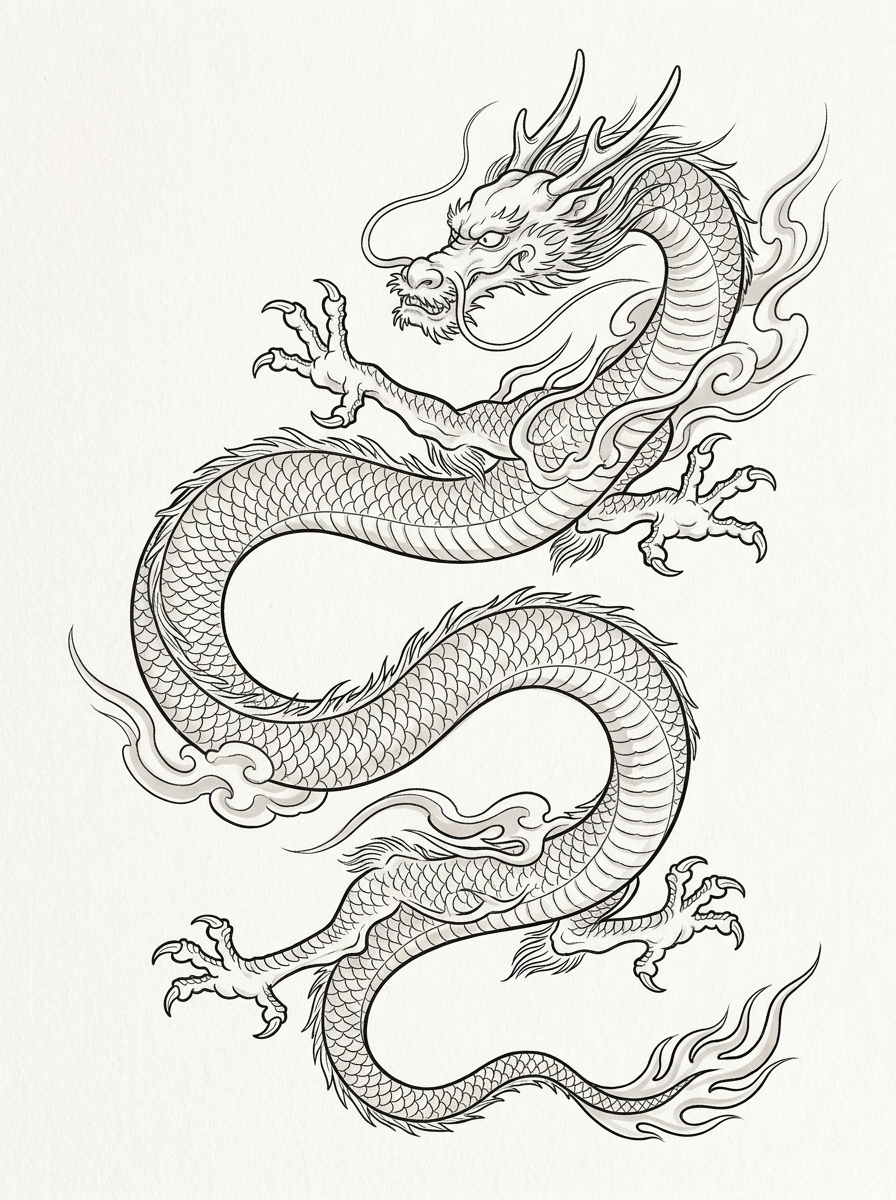
*Mǎng* is the python — the character carries 虫, the reptile radical, because the word began as the actual snake of the southern rivers and hills. Then the court borrowed it. By Ming and Qing times, 蟒 no longer meant only the animal: it named the robe one step below the dragon robe, worn by princes and high ministers. The rule people repeated was simple arithmetic — 「五爪为龙」, five claws make the dragon; 「四爪为蟒」, four make the mang. This design is a mang: every dragon line you expect, one toe short by regulation, not by accident.
蟒,本义是蟒蛇——字里带着「虫」旁,因为这个词最早就是南方水泽山岭里那条实实在在的大蛇。后来,朝廷把这个字借走了。到了明清,「蟒」不再只指动物,它命名了比龙袍低一级的官服:四爪,亲王与高官的正装。坊间流传的口诀是一道简单的算术:五爪为龙,四爪为蟒。 本设计就是一件蟒:你期待的所有龙的线条都在,只是每足少一趾——那是规制,不是失误。
Source & Provenance
The claw-count hierarchy is institutional history, not folklore: Ming–Qing dress statutes — the sumptuary rules recorded in the *History of Ming* treatise on clothing and the Qing statutory codes — set five-clawed dragons for the emperor and four-clawed mang robes beneath them. Song-dynasty dragons already drift to four claws, so the form itself is old; what Ming–Qing added was the legal meaning. The mang headed a whole family of "almost-dragon" bestowal robes — mang, flying-fish, dipper-bull — grants of favor one rank beneath the imperial. And the name stuck so deep that the Peking-opera costume trade still calls the emperor's stage robe a mang: on stage, even the Son of Heaven wears one.
爪数的尊卑是制度史,不是民俗传说:明清服制——见于《明史·舆服志》与清代会典的章服条文——定五爪龙为天子专有,四爪蟒服居其下。宋代的龙已有四爪渐多的画法,这个形制本身并不新;明清补上的是它的法律含义。蟒还领起了一整族「差一点是龙」的赐服——蟒、飞鱼、斗牛,都是恩宠加身、而名分在龙之下的纹样。这个名字扎根之深,以至于京剧戏班的行头行话里,台上帝王穿的袍子至今仍叫「蟒」——在台上,连天子穿的也是蟒。
Design Inspiration
Design Inspiration
Every form decision on this design points to a recorded source, element by element. ① The four-claw form — the rank rule written in the clothing treatise of the *History of Ming* and the Qing statutory codes. ② The nine resemblances — the composite dragon description (deer antlers, camel head, rabbit eyes, ox ears, fish scales, serpent body) transmitted from Han texts and codified in Song-era encyclopedias. ③ The descending S-posture — the pose traditional dragon iconography names the descending dragon, standard in Ming–Qing robes and paintings. ④ The baimiao outline method — the fine-line drawing tradition passed down through woodblock and textile pattern books.
本版每一处形制决定都有出处可查,逐条对账。① 四爪之制——见《明史·舆服志》与清代会典的章服条文。② 「九似」——汉代已见、宋代类书定型的龙形合成描述(鹿角、驼首、兔眼、牛耳、鱼鳞、蛇身)。③ 降龙式——传统龙纹图像志对这一姿态的命名,明清袍服与绘画通式。④ 白描线法——经版刻图谱与织绣花样传承的勾勒传统。
The Story
The Story
Here is the strange part: the empire took its most dangerous snake and made it the emblem of its most trusted men. The python is not a symbol you would invent for a court honor — it constricts, it swallows, it has no mythology of mercy. Yet Ming-Qing officialdom draped itself in the word. The reason is the arithmetic. A dragon robe differs from a mang robe by exactly one claw per foot, and every man walking the palace tiles could count. The mang was the visible distance between you and the throne — close enough to shimmer, far enough to stay legal. When the emperor granted a mang robe, he was saying: you may look like the dragon, because you have earned looking like it. And the court understood the message in both directions.
Then compare it with the dragon you were born to. The zodiac dragon — our 辰龙 — is assigned: no one chooses it, and folk wisdom says that in your 本命年 the bond pulls closest. The mang is the opposite document. Nothing about it is assigned. It is the rank you rise to, the robe you are granted rather than born wearing — the dragon that exists on the career track. Chinese culture kept both doors open: one beast for the year of your birth, another for what you make of the decades after it. Wear the dragon and you state where you began. Wear the mang and you state what you have built — with the quiet confidence of a figure who knows exactly how far from the throne he stands, and is in no hurry about the rest.
And there is a third life for the word, on stage. Peking opera keeps a full wardrobe of mang robes — emperors, generals, ministers, each rank cut differently — so for two centuries the Chinese stage has taught audiences to read rank by robe. The costume traders' rule of thumb is the whole culture in one sentence: the emperor plays in a mang, because on stage, as at court, the robe says the rank.
奇就奇在这里:帝国把最凶的蛇,拿来做了它最信重之人的徽章。蟒蛇这种动物,怎么编也编不成朝廷的恩典——它绞杀、它吞咽、它的神话里没有半分仁慈。可明清的官场偏偏把这个词穿在了身上。道理还是那道算术。龙袍与蟒袍,每足只差一爪,而紫禁城里每一个踩着金砖的人都数得清。蟒,就是你与御座之间那道看得见的距离——近得发光,远得合法。皇帝赐蟒,说的是:你可以像龙,因为你已经挣来了像龙的样子。这句话,朝堂上下两头都听得懂。
再对比那条生来就有的龙。属相之龙——我们的辰龙——是派定的:没人挑得了,民俗还说本命年缘分最紧。蟒则相反,是另一纸文书。它没有一样是派定的:它是你升上去的那个位置,是赐给你而不是你生下来就穿着的袍子——是仕途轨道上的那条龙。中国文化把两扇门都留着:一只给出生之年,一只给此后几十年的经营。纹龙,陈述的是你从哪里来;纹蟒,陈述的是你挣到了什么——带着一种从容:清楚自己离御座有多远,也不急着走完剩下的路。
这个词还有第三条命,在台上。京剧攒下了一整箱蟒袍——帝王、将相、大臣,品级不同裁法不同——两百年下来,中国戏台一直在教观众「看袍识品级」。行头行的老话一句话说尽这套文化:帝王上台穿的也是蟒——因为在台上,和在朝堂一样,袍子替人说话。
What It Means
What It Means
Earned standing. Ambition that operates inside a system and is recognized by it — promotion, mastery, the long climb made visible. The mang is the patron emblem of people who are done proving themselves loudly: it says the rank is real, the distance is known, and the one-claw gap is a chosen discipline rather than a shortfall. As a tattoo it is the connoisseur's dragon: most viewers will read "dragon"; the ones who count will read the whole Ming-Qing court — and those are the people this design is for.
挣来的位置。是在体系之内运作、并且被体系承认的野心——升迁、精进、把几十年的攀登穿在身上。蟒是这类人的守护纹:他们早已过了大声证明自己的阶段,它说的是:位置是真的,距离是清楚的,那一爪之差是自我约束,不是欠缺。作为纹身,蟒是给行家的龙:多数人看到的是「龙」;会数爪的人,看到的是整座明清朝堂——这张图,就是给后一种人的。
Where It Sits
Where It Sits
The open descending curve wants a long vertical field: down the spine with the head high near the nape and the tail settling at the waist, along the outer forearm, or down the outer calf. The composition reads best at 15–20 cm and up — the whole point is the unbroken sweep, so do not compress it. Head orientation is upward-and-outward by design; keep it that way.
这道开放的下降曲线,要一块竖长的地盘:沿脊柱走——头高踞后颈、尾收腰际;或走大臂外侧;或沿小腿外侧落下。15 厘米起步才放得开——它的全部意义在一笔不断的贯穿,不要压缩它。头朝上、朝外是设计本意,照这样落针。
Before You Ink
Before You Ink
The four toes are regulation. If your artist pauses at the paw and says one toe is missing, hand them this card: four per foot is the Ming–Qing mang standard, applied throughout by design. If what you actually want is the five-clawed imperial form, that is our 辰龙 design — the two are a deliberate pair, one claw apart. ② If you add the character 蟒: no script trap — it is written identically in simplified and traditional (unlike 龙/龍). As always, have a native speaker verify the final glyph; characters must be lettered by a person, never generated. ③ 蟒 alone reads "python." Out of context the character names the snake; the rank meaning lives in the robe-dragon form and the court story. Pair the design with a cloud band or keep the serpentine silhouette intact and the reading is unambiguous. ④ Run the nine resemblances. Deer antlers, camel head, rabbit eyes, whiskers, serpentine body, fish scales — the mang passes the same checklist as any dragon; that is exactly the point of it. ⑤ Ink-only by design, same rule as its counterpart chen-long. ⑥ Respect the scale. Back or upper arm, at least 15 cm — the belly-plate line and the four-toe regulation only read above that size.
四趾是规制。 如果你的纹身师在爪子上停笔,说少了一根趾——把这张卡递给他:每足四趾是明清蟒的规制,通体贯彻,是有意的。如果你要的其实是五爪帝王形制,那是本站的「辰龙」——两张是一对,差一爪,是有意的。② 如搭配汉字「蟒」:无字形之辨——简繁同形,不像龙/龍需要抉择;老规矩不变:动针前请母语者过目,汉字必须人写,绝不交给图像生成。③ 单写一个「蟒」字,读出来的是蟒蛇。 脱离语境,这个字指那条蛇;品级的含义住在袍与形里。给设计配一段云带,或保持蛇身的完整轮廓,读法就不会歧义。④ 「九似」照样过一遍。 鹿角、驼首、兔眼、长须、蛇身、鱼鳞——蟒与龙过的是同一张单子;这正是它存在的意义。⑤ 只宜墨线,与其对卡辰龙同理。⑥ 留够尺寸。 建议背部或大臂、不小于 15 厘米;腹甲线与四趾规制在这个尺寸以上才立得住。
Every character on this card was selected and checked stroke by stroke by a native reader of Chinese.