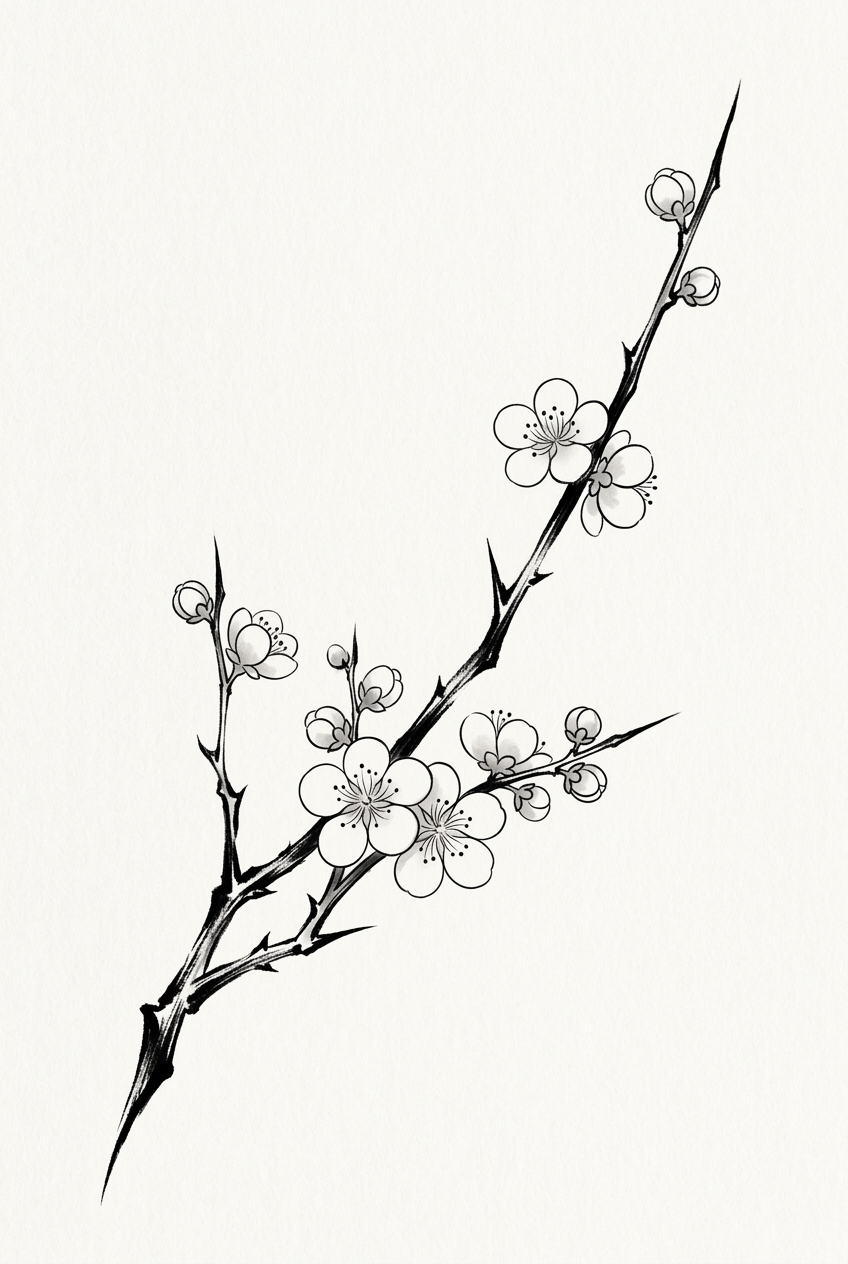
梅 · Méi
Plum Blossom, First Flower of the Year
Series: The Four Gentlemen · Design #01
Style: Slanting plum branch · fine-line negative space · optional 「梅」 character or one-line verse
Form: 图案+文字
The Name
*méi* — the plum blossom: the flower that blooms in snow. Five petals, round, opening on bare iron-dark branches before any leaf appears — the first flower of the Chinese year, and the hardest to earn.
梅(méi)——雪里开花的花。五瓣、瓣圆,在铁色秃枝上先于一切叶子开放:中国年的第一朵花,也是最难开的那一朵。
Source & Provenance
*Book of Songs, "Falling Plums"* (c. 11th–7th century BC) — the plum's earliest appearance in Chinese verse. Lin Bu, "Small Plum of the Mountain Garden" (967–1028): "Sparse shadows slant across shallow water; hidden fragrance drifts in the twilight" — the couplet that fixed plum aesthetics for a millennium. Wang Anshi, "Plum Blossoms": "In the corner of the wall, a few plum branches bloom alone in the cold." Cultural system: first of the Four Gentlemen (梅兰竹菊); one of the Three Friends of Winter (松竹梅). Historical form reference: The plum's traditional pictorial treatment appears on Song-Qing ceramics, ink painting and woodblock prints. No third-party source image was used for this design.
《诗经·摽有梅》(约前 11–前 7 世纪,梅入诗最早记录)。宋·林逋《山园小梅》(967–1028):疏影横斜水清浅,暗香浮动月黄昏——咏梅千古第一联。宋·王安石《梅花》:墙角数枝梅,凌寒独自开。文化体系:梅兰竹菊"四君子"之首;松竹梅"岁寒三友"。形制参考:梅花的传统表现形制见于宋至清的瓷器、水墨与版画。 本设计未使用任何第三方源图像。
Design Inspiration
Design Inspiration
Every form decision on this design points to a recorded source, element by element. ① The five-petal count — the fixed traditional number that separates the plum from the cherry blossom. ② The slanting-branch restraint — the aesthetic Lin Bu's couplet (967–1028) fixed for a millennium: admire the shadow and the scent, not the showy form. ③ The literary anchors — *Book of Songs*, "Falling Plums" (the plum's earliest appearance in verse); Wang Anshi's "blooming alone in the cold." ④ The pictorial treatment — Song–Qing ceramics, ink painting and woodblock prints.
本版每一处形制决定都有出处可查,逐条对账。① 五瓣之数——梅的传统定数,是与樱花相区分的第一特征。② 斜枝留白美学——林逋一联(967–1028)定下的千年观看方式:赏影闻香,不赏浓形。③ 文学锚点——《诗经·摽有梅》最早入诗;王安石「凌寒独自开」。④ 表现形制——宋至清的瓷器、水墨与版画。
The Story
The Story
In the Chinese ranking of flowers, there is a hidden hierarchy — and the plum blossom sits at its very top, for a gloriously defiant reason: every flower waits for spring. Only the plum blossoms into winter.
After the frost kills the others, when the earth sleeps, iron-dark buds swell on bare plum branches — and then, one by one, explode open in sub-zero air. Snow presses down on the petals; the petals do not flinch. Wind tears at the branches; the branches do not break. The Chinese have stood in the snow watching this for three thousand years, and the longer they watched, the less it looked like botany and the more it looked like character.
Two Song dynasty figures elevated the plum to divine status. One was the hermit Lin Bu, who never served at court, never married, and lived alone on a hill in West Lake planting plums and raising cranes — people said he had "married the plum and adopted the cranes." His line — "Sparse shadows slant across shallow water; hidden fragrance drifts in the twilight" — fixed how all of China would view the flower for the next millennium: you admire its shadow and inhale its scent, never the showy form. Plum beauty is the beauty of restraint. The other was Wang Anshi, the great reformer, deposed and exiled, who wrote of "a few plum branches in the corner of a wall, blooming alone in the bitter cold." Those corner-blooming plums were a self-portrait.
So the plum became first of the Four Gentlemen: orchid stands for solitude, bamboo for integrity, chrysanthemum for detachment — and the plum stands for adversity. Every gentleman eventually meets his winter: misunderstood, exiled, overlooked by his age. At such a time, which flower do you choose to be? The plum's answer: the colder it gets, the more you bloom — and if there is no audience, you bloom for heaven and earth.
There is also the proverb: the plum's fragrance comes precisely from the bitter cold. Its scent is not a gift; it is frozen out of it. For anyone enduring their own winter, this flower offers a choice: you do not have to wait for spring. You can define spring from inside the winter.
中国的花谱里有一条隐秘的鄙视链,而梅站在这条链的最顶端——理由很霸道:所有的花都挑春天开,只有梅,往冬天开。
霜降之后,百花谢幕,大地进入休眠。腊月里,梅枝上鼓出铁色的花苞,然后一朵一朵,在零下的空气里炸开。雪压在花上,花不躲;风撕着枝条,枝不折。中国人站在雪地里看这一幕,看了三千年,越看越觉得这不是植物学,是人格。
宋代出了两位把梅花推上神坛的人。一位是隐士林逋,终身不仕不娶,在西湖孤山种梅养鹤,人称"梅妻鹤子"。他写下的"疏影横斜水清浅,暗香浮动月黄昏",十四个字定了此后一千年中国人看梅花的角度——看的是影,闻的是香,都不是形,梅的美是留白的美。另一位是王安石,变法失败被罢相,独居南京,写"墙角数枝梅,凌寒独自开"——那几枝开在墙角的梅,就是他自己。
于是梅花成为"四君子"之首:兰谱幽、竹谱直、菊谱淡,梅谱的是逆境。君子在社会里难免挨冻——被误解、被贬谪、被时代冷落,这时候,你选择像什么花?梅给出的答案是:越是严寒,越要开花;没有观众,就香给天地看。
中国人还讲究"梅花香自苦寒来"——梅的冷香不是天赋,是被冻出来的。这给所有正在苦寒期的人提供了一个花的选择:不必等到春天,你可以在冬天定义春天。
What It Means
What It Means
Blooming alone in the bitter cold. The plum is adversity turned into active blooming — not "surviving the winter" but flowering inside it, turning hardship into the very hour of fragrance. For people rebuilding after a low point, for survivors, for anyone walking a road with few companions.
凌寒独自开。梅 = 逆境中的主动绽放。不是"熬过冬天",而是在冬天里开花——把苦难变成散发香气的时机。适合正在低谷期的人、康复者、独自走少有人走的路的人。
Where It Sits
Where It Sits
The slanting branch was made for the body's lines: along the collarbone, inner forearm, shoulder blade, or above the ankle. A fine 4–7 cm sprig is perfect for a first placement; a full horizontal branch (12–20 cm) carries the upper arm or ribs beautifully. An optional single vertical line of verse — 凌寒独自开 — completes the composition.
梅枝斜出的构图天然贴合身体线条:锁骨沿线、小臂内侧、肩胛、脚踝上方。细枝小图 4–7 厘米极佳;整枝横斜构图 12–20 厘米适合大臂/肋侧。可配一行"凌寒独自开"竖排小字收束。
Before You Ink
Before You Ink
The plum has exactly five petals — the fixed traditional number. Six petals means you're looking at a cherry blossom; sakura petals are notched at the tip, plum petals round. This is the single most common mix-up, and it changes what your tattoo says. ② White plum, red plum, and green-calyx plum carry different moods; in black ink the branch posture and five-petal structure do the talking. ③ If you add verse, verify the line and its punctuation — internet misquotations are everywhere ("暗香浮动月黄昏" is often miswritten). ④ Ink-only by design: color changes what it says — a red plum is a different subject. Black lines age steadiest. ⑤ Respect the scale. Blossoms at least 2 cm each (sprig at least 6 cm) or the stamen centers blur; keep the fine-line work off high-friction spots (wrist, ankle).
梅花为五瓣(中国传统固定数)——图源若出现六瓣是樱花特征,注意区分(樱花花瓣先端有缺口、梅花瓣圆)。这是最容易混的坑。② 白梅/红梅/绿萼梅气质不同:黑色 ink 下靠枝干姿态与五瓣结构表达。③ 配诗时确认字序与断句,勿用网络错版("暗香浮动月黄昏"常被误写)。④ 只宜墨线:上色即换语义——红梅是另一题材。黑线最耐老。⑤ 留够尺寸。 单朵不小于 2 厘米、整枝不小于 6 厘米,雄蕊点才不糊;细线避开手腕、脚踝等高磨损位。
Every character on this card was selected and checked stroke by stroke by a native reader of Chinese.